Showing posts with label vegetables. Show all posts
Tuesday, September 11, 2012
Yamagata Dashi 山形だし
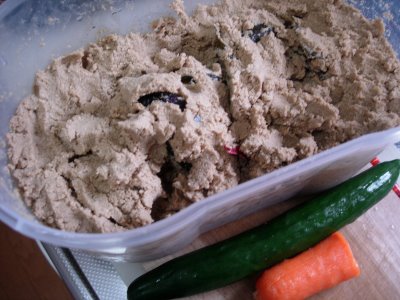
One of my addictions this time of year is Yamagata dashi. Simply finely chopped seasonal vegetables, mainly cucumbers, eggplants, and okra. It is best on a bowl of rice, but also on many other dishes like on boiled octopus (photo above) or over tofu (photo below).
Yamagata dashi is refreshing, especially on hot summer days when it is in season. It is a local dish from Yamagata where my mother is from.
If you are not keen on making it at home, it can be purchased at most supermarkets in August and into early September. The photos above are from the package above. It's a bit salty for my taste and is very easy to make at home.
Yamagata Dashi
1 eggplant
1 cucumber
4 okra
1 myoga
3 green shiso leaves
1 Tablespoon natto kombu
soy sauce, as needed
Mix the natto kombu with a bit of soy sauce and set aside. Finely mince the eggplant, cucumber, myoga, and shiso. Mix the natto kombu with a spoon until it's a bit sticky and then add the minced vegetables. This is the basic Yamagata Dashi and for me this is exactly as I like it. Simple is best. Optional additions include minced ginger, mirin, sake, dashi, ichimi togarashi (dried red chili pepper), katsuobushi, or toasted white sesame seeds.
Best over a bowl of steaming rice as in this photo. I suggest making it in small batches as the aroma of the myoga and shiso are best as soon as it's cut. The fresh vegetables also showcase their texture when it's freshly made.
Other serving suggestions include serving it with somen or soba, mixed with a light vinaigrette and used as a salad dressing.
Tuesday, July 10, 2012
Kiriboshi Daikon Sunomono
The sweet vinegar dressing on this dish reminds me of coleslaw for some reason. Perfect for a hot summer day.
kiriboshi daikon
carrots, julienned
ham, julienned
1 Tablespoon vinegar
2 teaspoons sugar
1 generous teaspoon soy sauce
Reconstitute the kiriboshi daikon in water for about 10-15 minutes. Not too long or the kiriboshi daikon will be too soft. Combine the vinegar, sugar, and soy sauce in a bowl and stir until the sugar dissolves. Add the kiriboshi daikon, carrots, and ham. Marinate for at least 20 minutes. Serve chilled or at room temperature.
Sunday, July 8, 2012
Sweet Potato Chips 野菜チップス
I was inspired to make chips from sweet potatoes after seeing a post by Andrea Nguyen. If I remember correctly, she was served these at a meal with food stylist Karen Shinto. For the first version I simply peeled long slices of sweet potato using a vegetable peeler. These fry up quickly and had a nice crunch.
This sweet potato was sliced with a mandolin and deep-fried. I much preferred the first version above. Keep the skin on the sweet potatoes for a nice pop of color in the bowl. Both of these are seasoned with salt.
You may also like renkon lotus root chips, which are so beautiful.
Monday, June 25, 2012
Celery Kinpira
Debra Samuels' book, My Japanese Table, is filled with great recipes. One recipe in particular is a dish I make when I come to my last few stalks of celery. Celery kinpira. Simply cut up the celery, saute in a bit of oil, and then add some sugar, sake, and soy sauce. For a little kick add some togarashi (dried red chili pepper) or shichimi togarashi. It's a great side dish to any meal with rice.
Monday, June 18, 2012
Kiriboshi Daikon Furikake
Kiriboshi daikon 切り干し大根 is something I always have in our pantry. Dried strips of daikon can be quickly reconstituted in water and is a simple way to add another vegetable dish to the table.
However, I get into the routine of always making the same dish time after time. Kiriboshi daikon simmered with some carrots and abura-age (deep-fried tofu) in a sweet soy broth. Sometimes I'll switch out the abura-age for some Satsuma-age (deep-fried fish cakes). Good, but not an exciting change from our old ways.
Today I had just a little bit of kiriboshi daikon left in a packet. I quickly rehydrated it in water, squeezed it of excess water, and cut it into small pieces. In a pan I sauteed it with some sesame oil, toasted sesame seeds, and salt. It was a nice change-up from the typical nimono (simmered dish) we have. I had it as furikake over rice, but will try it next time over a salad.
Monday, May 21, 2012
Bacon Wrapped Enoki Mushrooms
Who doesn't love bacon? While it may not be a traditional Japanese ingredient, bacon is used from time to time in the Japanese kitchen. This enoki bacon maki is a popular okazu or side dish. Best of all, it is good whether hot or at room temperature. These usually get eaten up quickly, so if I want to use some for a bento it's best to save a few.
I can't be bothered with toothpicks to secure them shut. So instead I use longer slices of bacon and wrap up the bunches of enoki. Just saute until the bacon is cooked and you have a nice addition to any dinner.
Sunday, June 12, 2011
Japanese Seasonal Vegetables - June
June is when the gardens start to burst with fresh vegetables. Following is a list of seasonal vegetables for the month of June. Perhaps the best place to see these prepared in a variety of dishes is in the prepared foods section of any depachika. My personal favorites are Takashimaya (Nihonbashi or Shinjuku) or Isetan in Shinjuku.
Salad greens
Lettuce
Kohlrabi
Radish
Asparagus
Celery
Parsley
Rhubarb
Beets
Mitsuba
Komatsuna
Tamanegi - onions
Fuki - butterbur
Ingen mame - green beans
Endomame - peas
Soramame - fava beans
Ninjin - carrots
Cabbage
Horenso - Spinach
Daikon
Togarashi - chili pepper
Bareisho - potato
Kyuri - Japanese cucumbers
Tomato
Salad greens
Lettuce
Kohlrabi
Radish
Asparagus
Celery
Parsley
Rhubarb
Beets
Mitsuba
Komatsuna
Tamanegi - onions
Fuki - butterbur
Ingen mame - green beans
Endomame - peas
Soramame - fava beans
Ninjin - carrots
Cabbage
Horenso - Spinach
Daikon
Togarashi - chili pepper
Bareisho - potato
Kyuri - Japanese cucumbers
Tomato
Sunday, May 29, 2011
Gazpacho Somen from NHK Asaichi

This morning on NHK's Asaichi TV program was a recipe for Gazpacho Somen. It looks so good I can not wait to make it. I have translated the recipe here below.
Serves Two
・I/4 onion
・1 Japanese cucumber
・1 red bell pepper
・1 stick celery
・2 tomatoes
・1/2 garlic clove
・150 ml. extra virgin olive oil
・50 ml. vinegar
・salt, pepper, and sugar to taste
・100 grams somen (somen for two people)
For the somen topping, mince some cucumber, red bell pepper, celery, and tomatoes and set aside.
The unused vegetables can be rough chopped and put into a blender or food processor with the garlic.
Add the extra virgin olive oil and vinegar and mix until smooth.
The gazpacho sauce can be used immediately, or for better results, let it rest in the fridge for two to three days. Will keep for about a week. At the very least the gazpacho should be chilled before serving.
Prepare the somen as directed on the package.
Top with the gazpacho and toppings.
Friday, May 13, 2011
Kabocha Soup かぼちゃスープ
For a dinner party recently I served this kabocha soup cold and it was a huge hit. It really is so easy, can be made in advance, and will keep for a few days in the fridge so worth making a big batch. It is good hot or cold, and even better when a bit of heavy cream is poured in at the last minute before serving.
Cut kabocha into small pieces, be sure to remove the green rind and all seeds.
Steam in a steamer until tender.
Smash with a fork or a masher.
Return smashed kabocha to a soup pan and add chicken stock until desired consistency.
Season with salt as needed.
Allow to cool in the fridge or serve immediately.
Wednesday, May 11, 2011
Crunchy Japanese Salad
A simple salad topping that adds both calcium and soy to your greens are chirimenjako (tiny sardines) and abura-age (deep-fried tofu). I like to fry the chirimenjako in a tiny bit of olive oil and then crisp the abura-age in a non-stick pan. Cut the abura-age into strips and top onto greens with the chirimenjako. Our favorite salad dressing for this is either a ponzu dressing (yuzu, soy sauce, mirin and olive oil) or a Chinese-style dressing of soy sauce, rice wine vinegar, and sesame oil. Both the abura-age and chirimenjako bring a nice texture to the salad.
Wednesday, May 4, 2011
Shortlist of Kanbutsu Dried Goods 乾物
The photos above are of hijiki and kiriboshi daikon .
KANBUTSU 乾物
Kanbutsu, the dried goods of both the sea and land, are key elements of the Japanese pantry. With a long shelf life, most are natural, without any added preservatives, and simply need to be reconstituted in water.
Here is a shortlist of essential kanbutsu items for your Japanese pantry.
Aonori – dried laver, often sprinkled on okonomiyaki
Aosa – dried laver, good in miso soup
Goma – sesame seeds
Irigoma – roasted sesame seeds
Kurogoma – black sesame seeds
Shirogoma – white sesame seeds
Surigoma – crushed sesame seeds
Hijiki – black sea vegetable rich in minerals and protein
Hoshi shiitake – dried shiitake mushrooms
Hoshi warabi – dried bracken, a type of sansai (mountain vegetable)
Hoshi zenmai – dried royal fern, a type of sansai (mountain vegetable)
Kaisou – generic term for sea vegetables, good for incorporating into salads
Kanpyo – dried gourd strip
Kanten – agar-agar made from tengusa (a sea vegetable), used as a gelatin
Kikurage – dried wood-ear mushroom
Kinako – flour made from dried soybeans, popular ingredient for wagashi
Kiriboshi daikon – dried strips of daikon
Kombu – sea vegetable, essential in making dashi
Koya dofu – freeze-dried tofu
Kuzuko – starch made from the kudzu plant, a thickening agent and popular ingredient with top chefs
Mame – generic term for beans
Azuki – little red beans, popular in wagashi
Daizu – soybeans
Kintoki – kidney beans
Kuromame – black beans
Men – generic term for noodles
Soba – buckwheat flour noodles
Soumen – thin wheat noodles
Udon – thick wheat noodles
Nori – dried laver, often used for rolled sushi
Wakame – sea vegetable, popular in miso soup and salads
Sunday, May 1, 2011
Shortlist of Sansai 山菜
SANSAI (Mountain Vegetables) 山菜
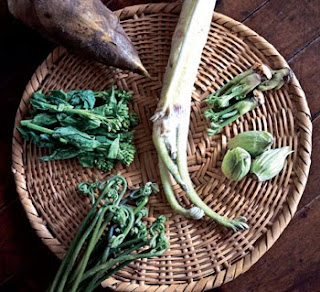
There are over 200 varieties of sansai, the mountain vegetables that spring forth from the ground in the spring. When sansai arrive at the market, you can overhear customers talk about the arrival of spring. It is served many ways including ohitashi (simmered), sunomono (vinegared), tempura, aemono (dressed with a sauce), and kinpira (julienned and stir-fried). Over a bowl of soba noodles the bitterness of the sansai is a nice contrast to the earthy buckwheat noodles. There is something special about the bitter vegetables when served up in tempura.
Here is a shortlist of some popular sansai:
あさつき Asatsuki – asatsuki chives
ふき Fuki – Japanese butterbur
ふきのとう Fuki no to – unopened bud of Japanese butterbur
片栗 Katakuri – dog’s tooth violet
こごみ Kogomi – fiddlehead of ostrich fern
のびる Nobiru – red garlic
せり Seri – water dropwort
たらの芽 Tara no me – shoot of the angelica tree
つくし Tsukushi – field horsetail shoot
ウド Udo - udo
わらび Warabi - bracken
よもぎ Yomogi - mugwort
ぜんまい Zenmai – royal fern
Friday, April 29, 2011
Nukazuke Pickles Recipe
Last year I had the privilege of interviewing chef MIchael Anthony of Gramercy Tavern in New York City for Food Arts magazine. He had spent some time in Kyoto training with some of the top chefs there and learned how to make nukazuke pickles. There is a recipe for nukazuke pickles in Food Arts magazine (I believe the September 2010 issue).
At Gramercy Tavern chef Michael Anthony serves up a variety of pickles, including nukazuke, or vegetables pickled in a fermenting mash of rice bran. Pickling in Japan is a great vehicle for vegetable scraps or parts of the vegetable that in most kitchen would immediately be discarded, such as the green leaves of a daikon.
* correction - in an earlier post I wrote that this recipe is from chef Michael Anthony. This is actually a basic nukazuke recipe from Japan. Sorry for any confusion or misunderstandings. Yukari
Nuka pickles are relatively easy to make and result in a unique pungent earthiness. The key to a successful nuka pot is that the mash needs to be mixed up daily. If left ignored it will begin to mold.
Basic Nukazuke
3 kg. nuka rice bran
500 grams salt
9 - 10 cups water or beer
5 dried red chili peppers (aka togarashi)
1 piece kombu
150 grams of vegetable scraps (cabbage skins, daikon greens, or any watery leaf)
Combine the ingredients into a large pot. The mash should feel like the soft spot of your earlobe, so adjust the amount of liquid accordingly. Keep the lidded pot in a cool place and stir daily for four days. On the fourth day remove the vegetable scraps, leaving the kombu in the pot. Thoroughly wash any vegetable you will pickle and put into the pot. Note that the vegetables do not need to be peeled. The amount of time for the vegetables to pickle will vary from pot to pot. Two to three days is the average for most vegetables. Almost any vegetable can be put into the nuka pot. When serving the pickles thoroughly rinse the bran off with cold water and cut into bite size pieces.
Popular vegetables for the nuka pot are Japanese cucumbers, daikon, carrots, Japanese radishes, and greens such as the leaves from the daikon. Anthony has found great success with sunchokes, parsnips, and watermelon radish. These are a nice contrast for his chicken liver mousse.
Nuka for pickling is available at Japanese supermarkets. Anthony procures his from Barry Farm in Wapakoneta, Ohio.
Once your pot is active there are many different adjustments that can be made. The capsaicin in dried red chili peppers will help to prevent the oxidization of the oil in the nuka. To increase umami add a piece of kombu, katsuobushi (dried bonito flakes), or dried, powdered shiitake. Calcium rich eggshells will neutralize the acidity. Note that the eggshells should be sterilized carefully in boiling water and dried before using. To add aromatic notes try sansho berries, garlic, ginger, or the skins of mikan (mandarin). Yaki myoban (alum) will help prevent the discoloration of eggplants. Any of these additives can be left in the pot as over time they will disintegrate.
Eventually the pot will have an excess of liquid, released from the vegetables. To rid the pot of the liquid create small pockets and insert a small sake cup. The liquid will collect in the cups.
Related links:
http://www.foodarts.com/
http://www.gramercytavern.com/
Sunday, April 24, 2011
Sansai -Spring Mountain Vegetables in The Japan Times

Very interesting and informative article on sansai in The Japan Times on Friday by Makiko Itoh.
http://search.japantimes.co.jp/mail/fg20110422f1.html
The unmistakable taste of a new season
Springtime in Japan means a selection of healthful bitter veg
By MAKIKO ITOH
Special to The Japan Times
In these days of year-round growing of vegetables in temperature-controlled conditions and air shipments of fresh produce from around the world, it's all too easy to forget the seasons. But in Japan, seasonality is still highly treasured, and there's no time like the spring to enjoy certain vegetables that are only available for a short time.
You'll see vegetables that are familiar to the Western palate, such as green asparagus, watercress, sora-mame (fava beans or broad beans) and green peas. There are also spring versions of sturdy year-round produce to enjoy, like tiny new potatoes and sweet spring cabbage. You may already be familiar with quintessential Japanese vegetables such as gobō (burdock root) and takenoko (bamboo shoots) — the ones gathered in the spring are particularly fresh and tender.
Joining these on the shelves of greengrocers for a short time in spring are several vegetables commonly known as sansai, or mountain vegetables. Many bear names for which there are no straightforward English translations: seri, tsukushi, fuki, tara no me and yama udo (more on these later).
While some sansai are cultivated these days, connoisseurs prefer the stronger bitterness of sansai gathered in the wild. Sansai went out of vogue for a while, but with the recent interest in health and "natural living" they've made a big comeback. Their bitter, even tannic quality is believed to have a salutary effect on the body, especially after a winter of stodgy food. According to folklore, bears waking up after their winter hibernation nibble on sansai to get their digestive systems going. Most sansai are also rich in vitamins and minerals as well as fiber.
If you're lucky, a neighbor may have gone sansai hunting in the countryside and come back with bounty to share. Sansai gathering used to be something only your grandmother bothered to do, but now hip urbanites go on organized gathering trips in the mountains on weekends. If you're interested in collecting your own sansai, make sure you go with an experienced guide at least for the first time. Just as with mushroom picking in the fall, there is the danger of mistaking a poisonous plant for an edible delicacy.
One caveat regarding sansai: It may not be advisable to eat the more bitter kinds in excess. Like certain medicinal herbs, too much of a good thing may lead to unfortunate side effects such as diarrhea or stomachache. In small quantities as part of a meal, they are fine, and a great way to savor springtime before the heat of the summer comes upon us.
Let's look at ways to prepare and enjoy some popular or unusual spring vegetables, starting with takenoko. While you can purchase precooked or canned bamboo shoots all year round, in spring you can find ones that have just been dug up from the ground. Fresh takenoko are usually sold with a little packet of nuka (rice bran). Peel off the dark skin of the takenoko until you get down to the pale beige part. Put the nuka in a pot of boiling water and add the takenoko; simmer for 20 to 30 minutes. (If you didn't get any nuka, you can also use the cloudy white water produced when rinsing rice instead.) Turn the heat off and let the takenoko rest in the water until cooled. Rinse well and cut up to use in tempura or in nimono (stewed dishes), cooked with rice, and so on.
Fuki no tō are the sprouts of the fuki plant: Peel off the outside stem-end parts (called the hakama, or "pants") plus any discolored bits. The sprouts can then be stewed in a mix of dashi stock, soy sauce, mirin and sugar, or turned into tempura (see recipe). The stems of the grown fuki plant are also eaten: Peel off the stringy outer parts, and stew as with the sprouts or blanch and marinate for a day or more in a miso, mirin and sugar base with a chili pepper added for a little spice.
Tara no me are the young offshoots of a tara tree, part of the aralia family. Most of the tara no me you can buy in stores these days are cultivated and are only mildly bitter. Take off the hakama as with fuki no tō, clean and use in tempura, blanched and served with soy sauce and bonito flakes, sauteed and so on.
Yama udo are offshoots of the udo tree, also from the aralia family, that are grown in the dark or with the earth mounded around them to blanch them, like white asparagus. Peel off and discard the tough, hairy outer skin, then peel the hard outer part of the white stem, leaving the tender core. Both parts should be soaked in water, with a little vinegar added, for 30 minutes to reduce the bitterness. Julienne the outer part and saute in sesame or olive oil; slice the core thinly and use raw in salads.
Warabi, or fiddlehead fern shoots, should be prepped by pouring boiling hot water over them and adding a pinch of bicarbonate of soda or wood ash. Leave to soak until the water is cool, then rinse and use in miso soup, salads and so on.
Wasabina or hawasabi are the young leaves of the wasabi plant. They have a mild wasabi taste and only need to be blanched for a few seconds, cooled and served with dashi stock and soy sauce. You can also saute them briefly in butter or olive oil, with a little chopped garlic, and serve them over hot pasta for a special treat.
Ki no me (which literally means "tree buds") are the tender young leaves of the sanshō pepper tree. Grind up the leaves to sprinkle as a condiment, or just use a small sprig as a garnish.
Recipe for spring vegetable tempura
Tempura is a great way to enjoy many spring vegetables without a lot of fuss. Deep-frying takes the edge off any bitterness, without the need for parboiling and so on. Here I've fried up some tara no me, fuki no tō, young gobō and seri. Serve with a little bit of salt to let the vegetable flavors shine though. Besides sea salt, you can find colorful matcha salt, yuzu salt, lemon salt, sakura salt and so on for sale in department-store food halls and better supermarkets.
Serves 4 as part of a Japanese meal
Seri, cut into 15-cm-long pieces — ?1 small bunch
Gobō (burdock root) cut into fine julienne — 1 15-cm piece
Fuki no tō — 15 to 20, bottoms trimmed
Tara no me e_SEmD 15 to 20, bottoms trimmed
Tempura flour or all-purpose flour — 110 g (about ? cup)
Potato starch or cornstarch (only if you're using all-purpose flour) — 2 tbsp
Large egg — 1
Ice water — 500 ml (2 cups)
Oil for deep frying, such as natane (canola/rapeseed) oil, peanut oil or "tempura oil"
Sea salt or special flavored salt as desired
The vegetables should be perfectly dry on the surface to ensure a crispy finish. Pat the washed and prepped vegetables dry with kitchen towels, or leave them out in a single layer on a sieve or basket until they have dried out completely. It's fine if they wilt a bit as they dry.
Put the vegetables into a large plastic bag with one-third of the flour (if using all-purpose flour and potato or cornstarch, mix together beforehand). Close the mouth of the bag and shake to coat the vegetables. Remove the vegetables, shaking off any excess flour.
In a large bowl, beat the egg and add about two-thirds of the ice water. Add the flour and mix lightly with a whisk or cooking chopsticks. Don't worry about any flour lumps or unmelted ice cubes; if you mix the batter too much, the tempura will become doughy. The batter should resemble thin unbeaten cream: If it looks too thick, add a bit more water; if too thin, a bit more flour.
Prepare a large plate or tray lined with newspaper, with a layer of paper towel on top, to drain the tempura. Fill a pot or wok no more than 1/3 with oil. Heat until quite hot: If you are using a thermometer, the temperature should be at least 175e_SDgr Celsius.
These tender vegetables cook very quickly, so should need no more than 30 seconds or so per side. Start with the fuki no tō, dipped and turned in the batter then into the oil one by one. Follow with the tara no me, also fried individually. Finally, toss together the seri leaves and gobō, and fry in small clusters. Do not overcrowd the pan at any time, and drain the cooked vegetables immediately.
Serve while piping hot and crisp, with ?a small mound of salt on the side of each plate.
Makiko Itoh is the author of "The Just Bento Cookbook" (Kodansha International). She writes about bento lunches at www.justbento.com and about Japanese cooking and more at www.justhungry.com.
Wednesday, April 20, 2011
Miso Recipes from National Public Radio

Miso is an indispensable pantry item in our kitchen. From miso soup, salad dressings, marinade for fish to adding umami to meat sauce for spaghetti or the ground meat mixture for tacos or even a pot of chili.
If you are reading this blog you most likely have some miso in your fridge. A miso producer advised me to keep the miso in the freezer, it keeps longer and it will never freeze solid so you can still spoon it out.
Eve Turow shares with National Public Radio some great recipes here on the link below:
http://www.npr.org/2011/04/20/135543251/miso-an-ancient-solution-for-modern-meals
Sunday, April 10, 2011
Kinpira Gobo きんぴらゴボウ
Mastering kinpira will add a wonderful dish to your kitchen repertoire. I usually make it with gobo (burdock root) and carrots, but it can be made with a variety of vegetables including renkon, celery, and even potatoes. The vegetables should be julienned, or if making from renkon, sliced thinly. Better yet, learn how to do the "sasagaki" cut, which results in vegetable shards that look like bamboo leaves (sasa).
Gobo should be soaked in water immediately after it is cut or it turns brown.
Cut your vegetables (julienne or sasagaki).
In a saute pan, stir-fry the vegetables in a bit of oil until the vegetables start to soften. Then season with sugar, soy sauce, sake and sesame oil. I do it all to taste but if you are looking for rough amounts:
1 burdock root
1 carrot
1 Tablespoon soy sauce
1 Tablespoon sugar
2 teaspoons sake
1 Tablespoon sesame oil
If you like a bit of spice feel free to add either dried chili sliced thinly or shichimi togarashi. Toasteds sesame seeds are also a nice compliment.
This dish can be eaten hot or cold, so is perfect for adding to a bento. For a vegetarian sandwich, toss with some mayonnaise and serve with bread.
Friday, April 8, 2011
Soy Simmered Hoshi Shiitake (Dried Shiitake Mushrooms)
Dried shiitake mushrooms (hoshi shiitake 干ししいたけ) are always good to have in the pantry as they have a long shelf life and can be used for many dishes.
To rehydrate the mushrooms place in a large bowl of water and put a drop-lid (otoshibuta) over it to keep the mushrooms submerged. If you don't have a drop-lid you can make a disposable one using aluminum foil.
After the mushrooms are rehydrated they can be left whole to simmer in the soy broth. In this version I sliced them.
Soy simmering broth:
2 Tablespoons soy sauce
1 Tablespoon mirin
1 Tablespoon sugar
1 Tablespoon sake
dash of salt
Add the rehyrdrated mushrooms to the soy broth and simmer until mushrooms have taken the flavor of the soy broth. If there is not enough broth to cover the mushrooms just double the recipe above.
The soy simmered mushrooms can be served on their own as a side dish, or in this version, as part of a Korean-style donburi (rice bowl).
Wednesday, August 18, 2010
Sesame Vegetables
I am often asked for tips to help kids eat vegetables. One of my favorite quick and easy recipes is this sesame dressing. Crush some toasted sesame seeds (white or black) in a mortar and pestle. Add a bit of sugar and soy sauce to taste. That's it. This can be used to top any steamed vegetable. Most often I use it for greens like spinach, broccoli, and green beans but it also works for carrots.
When making Shinji's bento I try and incorporate five colors. Red, white, yellow, green, and black. Black can be hard to incorporate if you don't make hijiki. This sesame dressing with black sesame seeds is a good way to include black.
Friday, August 6, 2010
Simmered Kabocha 南瓜の煮物
Kabocha is one of my favorite Japanese vegetables. Much like a pumpkin, but with a denser, sweeter flavor. This dish is a bit labor intensive in prep, but definitely worth the few extra steps. I remember at culinary school, at the French Culinary Institute, chef Jacques Pepin talking about taking the extra steps to make a good dish. I don't remember if he said we do this because we are chefs, or this is what makes chefs different from home cooks, or if we just should not take shortcuts if we know that there is a better dish to be made. Regardless, the dish will be better if you can do full prep.
Cut the kabocha into bite size pieces. Cut the inside of the kabocha, to rid of the soft spot where the seeds were. Then cut the four edges of the skin. This is the key step not to skip. It will soften the edges which may be off-putting when eating later after it is simmered. Finally, score the skin to rid of any rough spots and to create areas to help the kabocha simmer.
1/2 kabocha
3 1/2 cups dashi
1/2 cup sake
1/2 cup mirin
1/4 cup sugar
In a pot combine all of the ingredients. Cook until the kabocha is tender. Will keep for several days.
This dish is often served at room temperature.
Wednesday, June 2, 2010
Vietnamese Spring Roll Salad
Our favorite neighborhood restaurant is Nha Trang, a Vietnamese restaurant introduced to me by a dear Vietnamese friend. Most of the customers are Vietnamese and the menu is long and diverse. But, I always tend to go back to the same dish, a salad that is topped with spring rolls or caramelized pork, or a combination of the two.
We often make fresh spring rolls at home but was inspired to trying to recreate the salad at home the other day. And, were surprised at the success.
The recipe came from Corrine Trang's Authentic Vietnamese Cooking - a great resource for many Vietnamese dishes.
Subscribe to:
Posts (Atom)